Exploratorium · 2011–2013
Uncovered Series
“I don’t quite know what to call Color Uncovered. . . . it feels like an elegantly designed museum exhibit poured into an iPad.”
Carl Zimmer, downloadtheuniverse.com
Something new from something old
I was hired as the Exploratorium’s first multimedia specialist. Early on I worked on small teams, making exhibits on the floor and online. Years later I was asked to lead the online engagement group, a much wider range of craft than I’d managed before: science writers, editors, photographers, graphic designers, all deep in Exploratorium culture and nearly all hired for a specialty. I wasn’t a science writer. But I knew how good they were and what we could build together.
By then the museum’s strategy was to expand what it could be virtually, and the push I wanted next was mobile. The iPad had just come out and it looked like the right place to put the old and the new together.
Several of the group came out of book and magazine publishing. So we started from a metaphor they already knew, an interactive book, and folded in the way exhibits work on the floor. What came out was neither. It was a take-home science experience that invites you to discover alongside it.
Translating a way of learning
The hard part was never ideas. There is no shortage of those at the Exploratorium. It was carrying over how the museum teaches. An exhibit works because you walk up to it and something happens in front of you, and most of what makes that work doesn’t survive being described on a screen.
What makes an Exploratorium exhibit good is that it’s authentic. You never feel tricked, or misled, or handed a result you can’t check. The best learning experiences lead you to your own moment of discovery rather than announcing one. That’s easy to lose in software, where the machine can just tell you the answer and you have to take it.
Expose the technology
So the principle we worked from was to expose the technology wherever we could, rather than let the content vanish into a black box.
Two examples show what that meant in practice. One activity has you hold a CD jewel case up to the screen as a prism, so additive color mixing happens in your hands with an object you already own. Another asks you to put a drop of water on your tablet’s screen, which magnifies the display enough to reveal the individual LEDs underneath.
In both, the iPad stops being a thing that shows you a fact and becomes the thing you’re experimenting on.
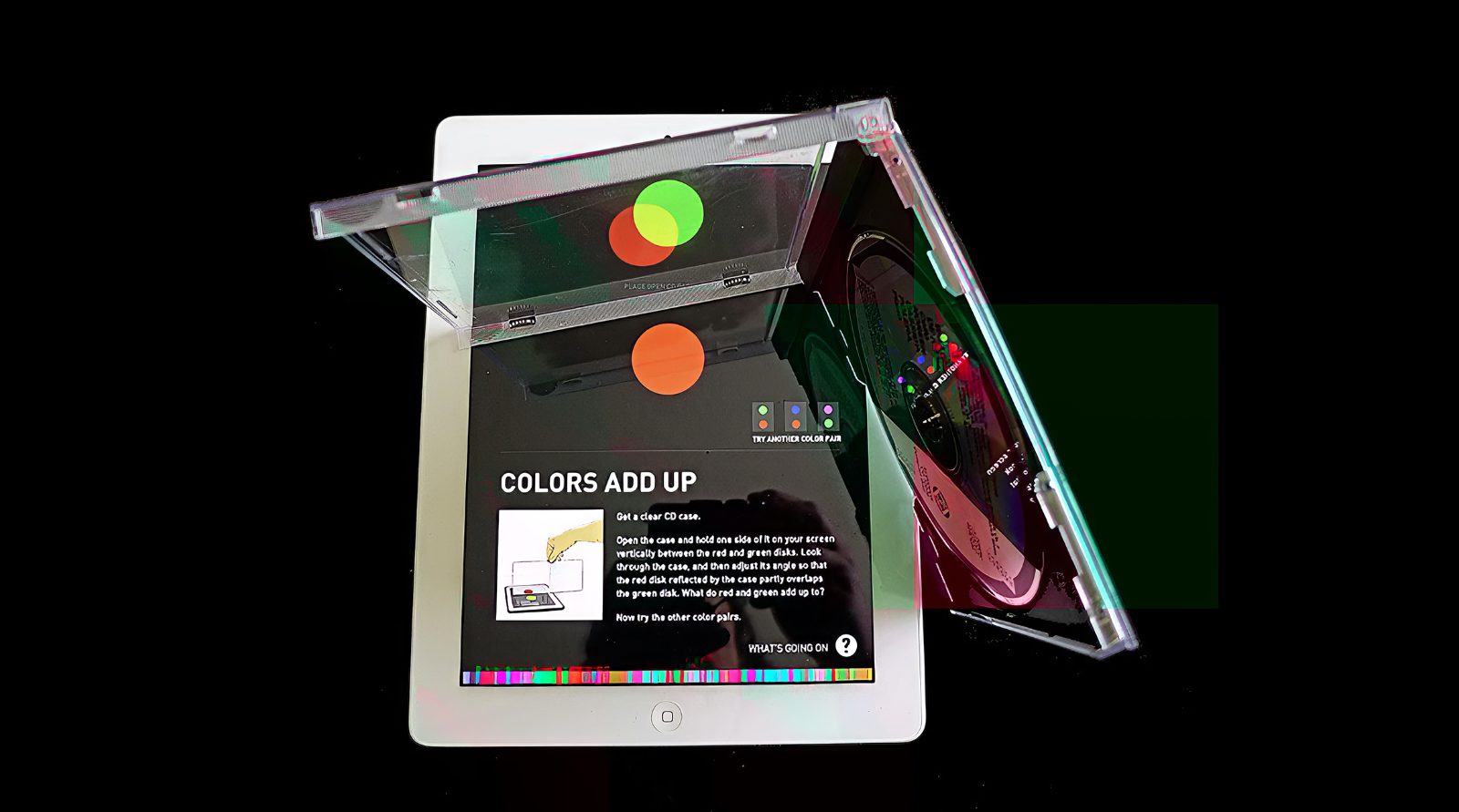
You’re not trusting a demonstration. You’re doing one, and you can see how it works.
Why tablets
Almost nothing at the Exploratorium is designed for one person. Exhibits can be approached from several sides, with room to engage, to watch, or to talk about what just happened. The exhibit is a hub for a group.
In 2011 the industry was going phone first. But phones are intimate, and an intimate device is the wrong place to put a social experience. A tablet sits on a table and several people can be around it, which is closer to a small exhibit than a phone will ever be.
That decision came from watching how people behave on a museum floor, not from where the platform was heading.
What happened
Color Uncovered reached number one in free educational iPad apps and the top ten free apps overall on iTunes at launch, ranked in 120 app stores, and has been downloaded over a million times.
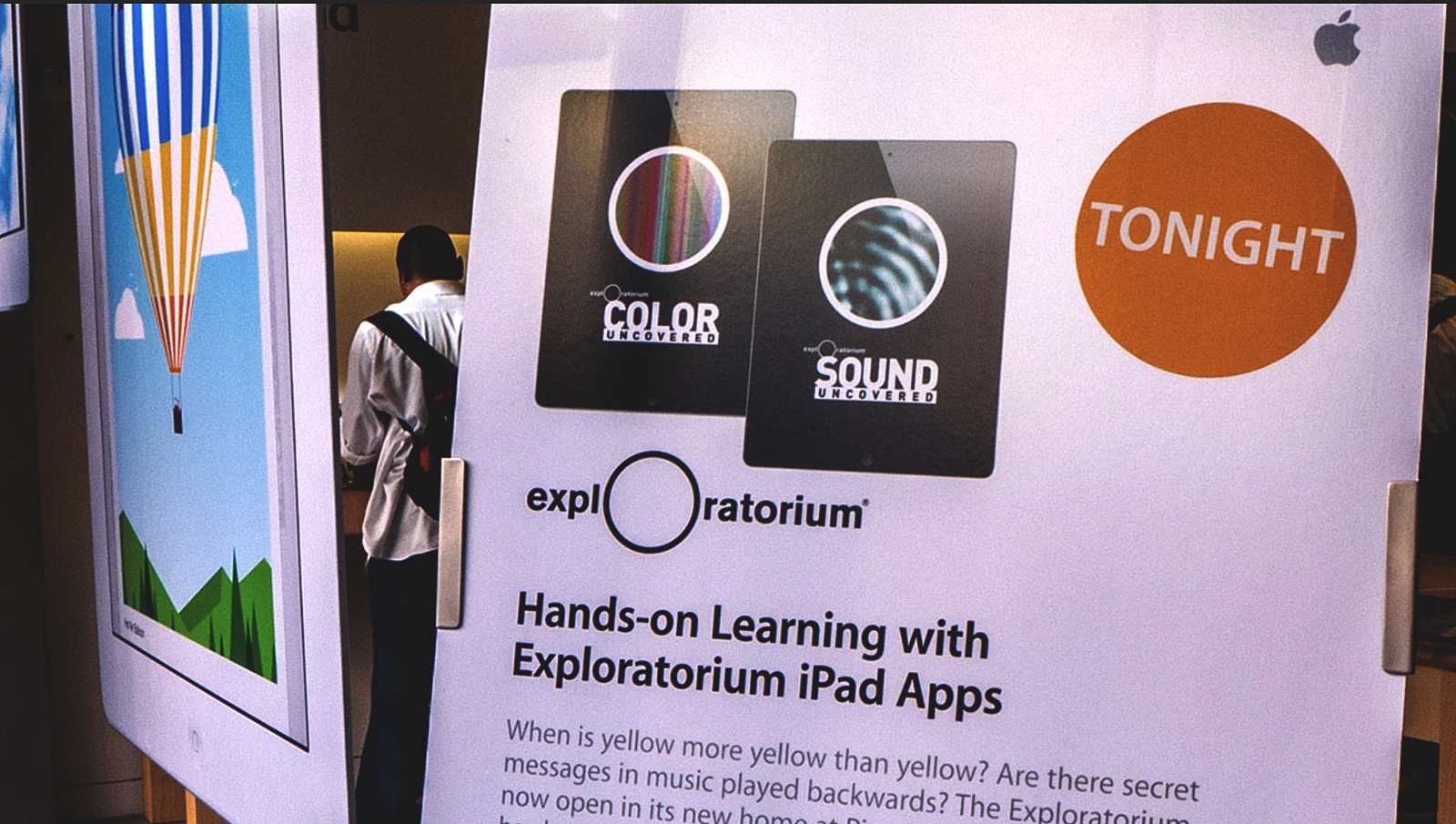
Sound Uncovered followed in February 2013, twelve experiments in listening, funded by the Moore Foundation. It shipped two months before the museum opened at Pier 15, while the Exploratorium was between buildings. For a stretch there it was the thing press could point at when they wanted to show what the Exploratorium is, because there was no floor to walk. A take-home version of a museum nobody could visit yet. It won the Jackson Hole Science Media Award for Best Online and Interactive Media, Best of the Web for Mobile, and a Silver MUSE.
Neither is available now. They were built for that era’s hardware and didn’t survive fifteen years of OS changes.
What did we learn
Design the project so the team can make it.
An interactive book grew out of a space writers and editors already knew, so they could do their best work in it. We broke from tradition by holding onto some of it. The familiar part is what let the unfamiliar part work.
Show the process
When a system just delivers a result, you have to take it on faith. Show someone the process and you’ve changed what kind of thing you made.
None of that was mine. Frank Oppenheimer built the Exploratorium on it. Exhibits with their mechanisms visible, nothing sealed in a box, because understanding how a thing works is inseparable from believing what it shows you.
Every frontier model now displays its reasoning and cites its sources, and that gets treated as a new idea about trust. It isn’t. It’s the idea I spent twenty years carrying out of a museum and into everything else.
Design for how people actually behave, not for where the platform is going.
Phone first was the obvious call in 2011. It was also the wrong one for content built on people looking at something together.
Translating a way of learning into a new medium is the work.
We had no shortage of ideas. The hard part was carrying over how the Exploratorium teaches, where you do something and find out, rather than just carrying over what it teaches.